
Last Updated: November 24, 2026
Quick Summary
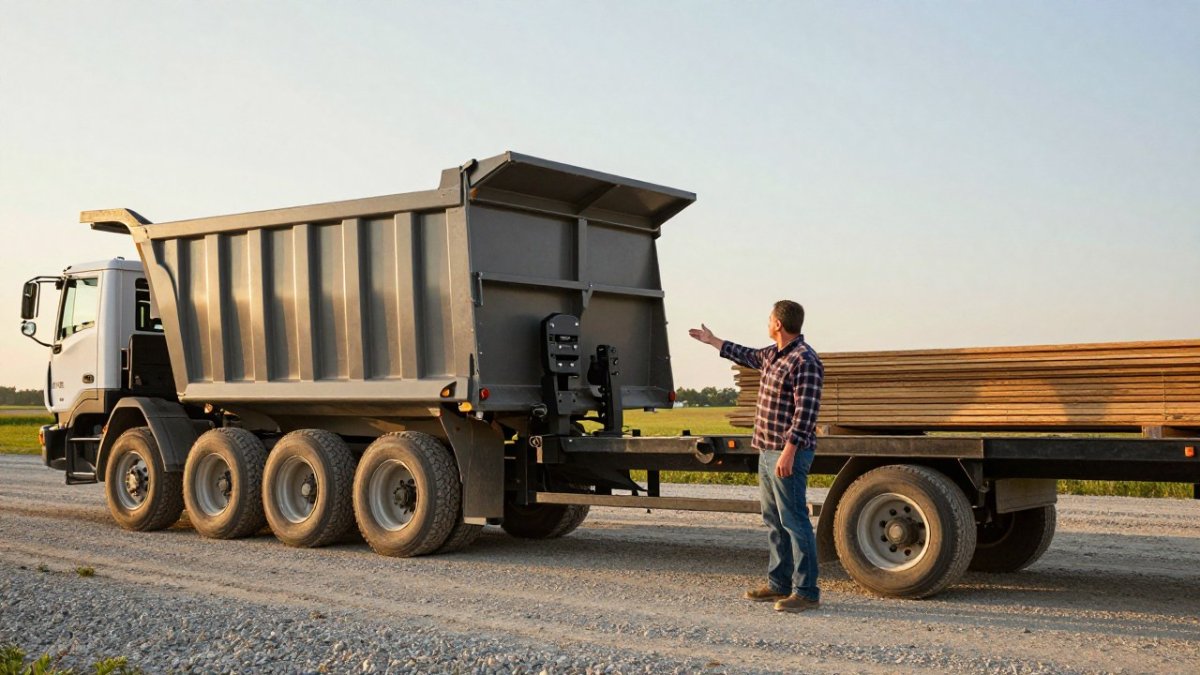
The dump trailer vs flatbed trailer for hauling decision comes down to how cargo leaves the trailer: a dump trailer self-unloads loose material with a hydraulic bed, while a flatbed carries equipment and pallets on an open deck. Choose a dump trailer for dirt, gravel, and debris, and a flatbed for tractors, pallets, and building materials.
- A dump bed empties in under a minute, while flatbed debris must be unloaded by hand or machine.
- Two trailers with a 10,000 lb GVWR can differ by a full ton of payload due to the dump trailer's hydraulics and steel bed.
- Tongue weight should land around 10 to 15 percent of loaded trailer weight for a bumper-pull setup.
- Use four-point securement on wheeled equipment, with straps or chains rated above the load weight.
- If more than roughly half your loads are loose material or debris, a dump trailer earns its keep.
Table of Contents
- Dump Trailer vs Flatbed Trailer: The Core Difference
- Quick Comparison: Dump vs Flatbed at a Glance
- Best Hauling Jobs for a Dump Trailer
- Best Hauling Jobs for a Flatbed Trailer
- Best Trailer for Hauling a Tractor: Dump or Flatbed?
- Dump Trailer Payload Capacity and Weight Ratings Explained
- Flatbed Trailer Loading and Tie-Downs Done Right
- Dump Trailer Buying Guide: Sizing, Axles, and Tow Vehicle Match
- Frequently Asked Questions
Dump Trailer vs Flatbed Trailer: The Core Difference
The core difference in the dump trailer vs flatbed trailer for hauling decision comes down to how cargo leaves the trailer.
That single design choice decides almost everything else: what you can haul, how fast you unload, and how much of your day disappears into handling material.
Below, we break down both trailer types job by job, cover payload math most guides skip, and show you how to match a trailer to your tow vehicle.
Quick Comparison: Dump vs Flatbed at a Glance
A dump trailer wins for loose materials and disposal runs. A flatbed trailer wins for machinery, pallets, and mixed cargo. Here is the side-by-side:
| Feature | Dump Trailer | Flatbed Trailer |
|---|---|---|
| Primary cargo | Dirt, gravel, mulch, debris | Equipment, pallets, materials |
| Unloading method | Hydraulic lift, self-unloading | Ramps, forklift, winch |
| Loading height | Higher sides, harder to load | Open deck, easy access |
| Best for | Landscaping, construction debris | Tractors, pavers, lumber |
| Cargo securement | Sides contain the load | Requires tie-downs |
| Versatility | Narrower use case | Wider range of loads |
Best Hauling Jobs for a Dump Trailer
Dump trailers earn their keep on jobs where material arrives loose and leaves in bulk. Landscaping crews, excavation contractors, and property managers are the classic buyers.
Loose Materials and Construction Debris
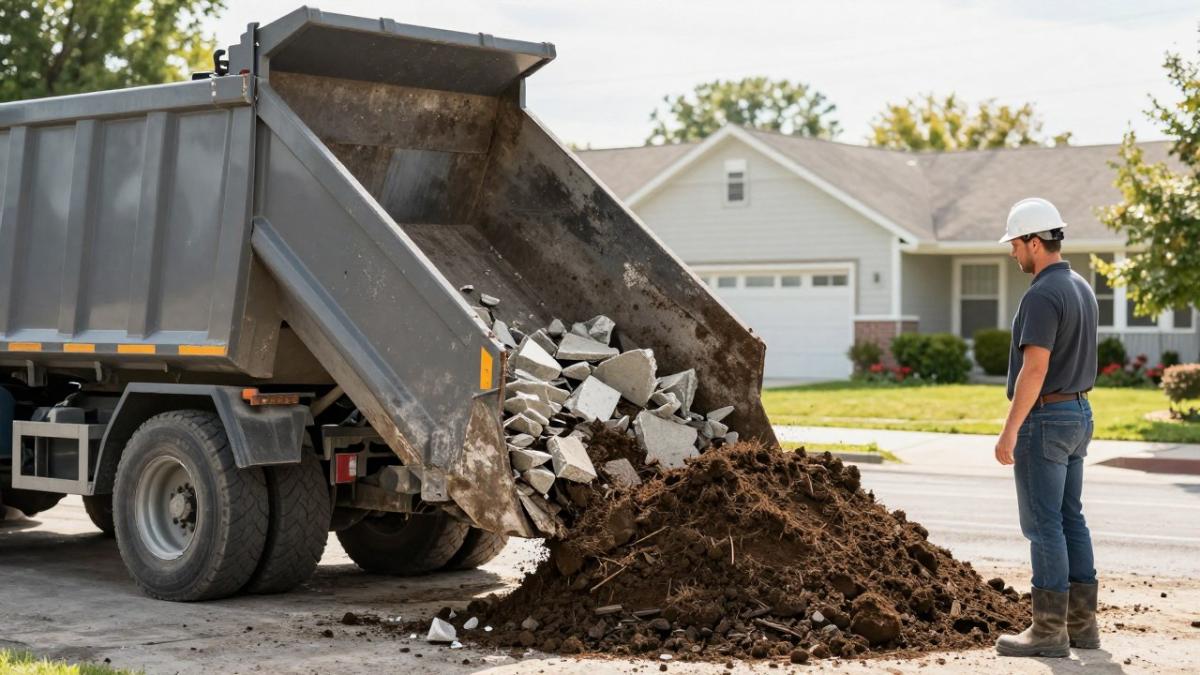
Dirt, gravel, mulch, sand, and construction debris are the dump trailer's home turf. You load with a skid steer or by shovel, drive to the site, and the hydraulic lift tips the bed until the load slides out.
That matters on disposal runs. A flatbed loaded with debris has to be unloaded by hand or machine at the dump. A dump bed empties in under a minute, which is why hauling frequency changes the math so much.
When Self-Unloading Saves You Time and Money
Self-unloading pays off whenever you make repeat trips. A landscaper running mulch deliveries all week feels the difference immediately. Every stop is faster, and faster stops mean more jobs per day.
Dump fees and fuel costs also shrink when you are not idling at a transfer station waiting to hand-unload. The trade-off: a dump trailer's sides make it awkward for anything that is not loose or bulky.
Best Hauling Jobs for a Flatbed Trailer
Flatbeds handle the loads a dump bed cannot: rolling machinery, pallets, and building materials that need a flat, open surface. If your cargo has wheels or a pallet under it, a flatbed is usually the better fit.
Pallets, Building Materials, and Rolling Machinery
Pallets of pavers, bundles of lumber, and skid-steer attachments all load easily onto an open deck. So do small tractors and rolling machinery that drive up ramps.
The open deck is the whole point. You get full-length access from either side, so a forklift can set a pallet down anywhere on the deck.
Where a flatbed falls short is loose material. Mulch, gravel, and dirt need sides to stay contained, and a flatbed has none unless you add them.
Best Trailer for Hauling a Tractor: Dump or Flatbed?
For hauling a tractor, a flatbed trailer is almost always the better choice. Tractors roll, and a flatbed gives you ramps, a flat deck, and room to tie down at all four corners.
For the full picture on equipment hauling, our guide to choosing the right trailer for farm equipment covers deck lengths, ramp setups, and tie-down points for tractors and implements.
Dump Trailer Payload Capacity and Weight Ratings Explained
Payload capacity is the weight of cargo a trailer can legally carry, and it equals the gross vehicle weight rating minus the trailer's empty weight. Buyers get this wrong constantly.
Here is the math that matters:
- GVWR is the maximum the fully loaded trailer can weigh, including the trailer itself.
- Empty weight (sometimes called curb weight) is what the trailer weighs with nothing on it.
- Payload is GVWR minus empty weight, the cargo you can actually add.
- Axle rating caps what the axles can carry, and it must cover the payload plus the trailer's own weight on the axles.
- Tongue weight is the downward force the loaded trailer puts on the hitch, and it counts against your tow vehicle's payload and hitch rating.
A worked example makes the difference obvious. Suppose two trailers share a 10,000 lb GVWR.
Axle ratings tighten the picture further.
Tongue weight is a number buyers often overlook. A conventional rule of thumb is that tongue weight should land around 10 to 15 percent of the loaded trailer weight for a bumper-pull setup.
A dump trailer's hydraulic system and steel bed add empty weight, which reduces payload. Our guide on how to tow a heavy contractor trailer safely walks through hitch class, trailer brakes, and weight distribution in detail.
Flatbed Trailer Loading and Tie-Downs Done Right
Flatbed loading starts with the right approach angle. Ramps should sit at a shallow angle for rolling machinery, and you want them rated for the load plus a margin.
Tie-downs are where flatbed hauling earns or loses its safety record. Use four-point securement on wheeled equipment, with straps or chains rated above the load weight.
Deck condition matters too. Our article on how to choose trailer flooring for heavy equipment covers what holds up under tracked and wheeled machines.
Dump Trailer Buying Guide: Sizing, Axles, and Tow Vehicle Match
Sizing a dump trailer starts with deck length and load type. A shorter bed suits tight job sites and lighter loads; a longer bed carries more material per trip but demands more tow vehicle. Axle count follows payload: tandem axles are the norm for serious hauling, and the axle rating must cover the loaded weight. But sizing is only half the decision.
Tow Vehicle, Hitch, and Brake Compatibility Checklist
Before you commit to any trailer, run this checklist against the truck you will actually tow with:
- Towing capacity: Compare your vehicle's rated towing capacity to the trailer's GVWR, not its empty weight. A half-ton pickup rated around 7,000 to 9,000 lb may be near its limit with a loaded 10,000 lb dump trailer.
- Hitch class and rating: Hitch classes carry rated trailer and tongue weight limits, so confirm the rating on your specific hitch before you tow. Match the hitch to the loaded trailer, and use a weight-distributing hitch if the tongue weight exceeds your receiver's dead-weight rating.
- Brake controller: Trailer brake requirements vary by state and are set by weight thresholds, so check your state's rules before you tow. Confirm your truck has one or budget for installation.
- Trailer brakes: Surge brakes are common on rental and lighter trailers; electric brakes are the norm on heavy dump and flatbed trailers. Make sure the trailer's brake type matches what your controller supports.
- Ball size and coupler: A 2-inch ball suits lighter trailers; 2 5/16-inch is standard on heavier equipment. A mismatched coupler is a safety failure, not an inconvenience.
- Payload and rear axle rating: Tongue weight counts against your truck's payload and rear axle rating. A truck that can pull the weight may still be overloaded by the tongue.
Watch out: a truck rated to pull a trailer is not automatically rated to stop it or carry its tongue weight. Check all three ratings, towing, payload, and rear axle, before you buy.
Total Cost of Ownership, Not Just Sticker Price
The purchase price is the easy number to compare and the least useful one over time. A dump trailer carries hydraulic-system maintenance, pump, cylinder, hoses, and fluid, that a flatbed simply does not have.
On the operating side, the dump trailer's self-unloading can cut labor hours and reduce idling at transfer stations, which offsets some of its higher purchase and maintenance cost on high-frequency disposal work.
One Trailer, Two Trailers, or a Compromise?
If your workload is mixed, some loose material, some equipment, the decision is rarely a clean either/or. Three practical paths exist:
- Buy the trailer that matches your most common load and rent the other type for occasional jobs. This is usually the lowest-cost path for a single-truck operation.
- Buy both if you haul enough of each to keep two trailers busy. Two trailers mean two registrations, two insurance lines, and more storage space, so the volume has to justify it.
- Consider a compromise configuration such as a flatbed with removable side kits, or a dump trailer with a ramp gate and enough deck length to roll small equipment aboard. Neither is a perfect substitute, but each covers the middle ground.
A simple decision rule: if more than roughly half your loads are loose material or debris, a dump trailer earns its keep. If more than half are equipment, pallets, or building materials, a flatbed does.
Our heavy duty dump trailer buying guide breaks down sizing, axle configurations, and tow vehicle matching step by step. And once you own one, our guide on maintaining dump trailer hydraulic systems keeps the lift working season after season.
If your workload changes with the seasons, buy for the job you do most and rent for the rest. Mixed workloads are the one case where neither trailer is a perfect fit on its own.
Frequently Asked Questions
What is the difference between a dump trailer and a flatbed trailer?
A dump trailer carries loose material in an enclosed bed that tilts up with a hydraulic lift to dump its load. A flatbed trailer has an open deck with no sides, so you drive or lift cargo onto it and secure it with tie-downs. Dump trailers suit dirt, gravel, mulch, and construction debris. Flatbeds suit pallets, building materials, tractors, and rolling machinery. Your cargo type, not trailer size, should drive the choice.
Can a flatbed trailer haul gravel or other loose materials?
Only with extra equipment. A flatbed has no walls to hold loose material, so gravel, dirt, or mulch will spill unless you add side rails or load it in bags, bins, or on pallets. For regular bulk delivery of loose materials, a dump trailer is the practical choice because the bed contains the load and the hydraulic lift empties it without shoveling.
What should I check for dump trailer payload capacity before buying?
Start with the gross vehicle weight rating, then subtract the trailer's empty weight to get the real load capacity. Check the axle ratings too, since they can cap payload below the advertised number. Finally, confirm your tow vehicle's towing capacity and hitch rating exceed the loaded trailer weight. A trailer that overloads your truck is a safety problem, not a bargain.
Can I haul my tractor in a dump trailer?
Sometimes, but a flatbed is usually the better trailer for hauling a tractor. Dump beds have high sides that make loading with ramps awkward, and the bed floor may not be rated for concentrated wheel loads. A flatbed gives you a low, open deck, easier ramp angles, and more tie-down points. If you haul equipment often, choose the flatbed and rent a dump trailer for debris.
Are dump trailers worth the money compared to a flatbed?
It depends on hauling frequency and cargo. If most of your loads are dirt, gravel, mulch, or construction debris, a dump trailer pays for itself by cutting dump fees, fuel costs, and manual unloading time. If your loads are pallets, materials, or machinery, a flatbed costs less to buy and maintain and handles more cargo types. Match the trailer to the work you actually do each week.
